In this guide
It usually starts small. You're coming down a long hill or off the freeway, you press the brake, and the steering wheel starts to shimmy in your hands. Ease off the pedal and it smooths right out. A lot of drivers first notice it on the long I-680 grade coming down from Sunol into Fremont, or on an 880 off-ramp where you go from freeway speed to a red light in a few hundred feet.
That detail, shaking only when you brake, is the most useful clue you have. It tells you to look at the brakes first. It's also one of the most common things drivers in Fremont, Newark, Union City and Hayward call us about.

Why the shake shows up when you brake
When you press the pedal, the caliper squeezes the brake pads against a spinning metal disc called the rotor. If the rotor's surface is even, the pads get a smooth, steady grip and the car slows down without any drama.
If the rotor isn't even, the grip isn't either. On every turn of the wheel, the pads hit a thicker or grippier spot, then a thinner one. That on-and-off pulse travels through the front suspension into the steering, and you feel it in the wheel. The faster you're going, the faster the pulses come, which is why it's often worst when braking from freeway speed and fades as the car slows.
Rotors: the usual suspect
Most people call this “warped rotors,” and that's the name you'll hear at most shops, ours included. In practice, the rotor usually isn't bent. More often the surface has worn unevenly, or pad material has built up in patches, so the rotor's thickness varies by a tiny amount around the disc. A tiny amount is plenty. You can feel it at the steering wheel long before anyone could see it.
A few common reasons it happens:
- Heat from long or hard stops. Riding the brakes down a long grade, or several hard stops in a row, gets the rotors very hot. The 680 grade and the hills above Hayward and Fremont both count.
- Holding the pedal down after a hot stop. Sitting at the bottom of an off-ramp with your foot pressed hard on the brake can leave a patch of pad material on a hot rotor.
- Unevenly tightened wheel nuts. If the lug nuts weren't tightened evenly the last time the wheels came off, the rotor can end up slightly out of true.
- Worn pads and thin rotors. Rotors that are worn thin don't handle heat as well. If your pads are near the end too, our guide on how long brake pads last covers the other warning signs.
- Parts that don't hold up to heat. Lower-quality pads and rotors tend to develop this problem sooner. It's one reason we use OEM-quality or premium parts.
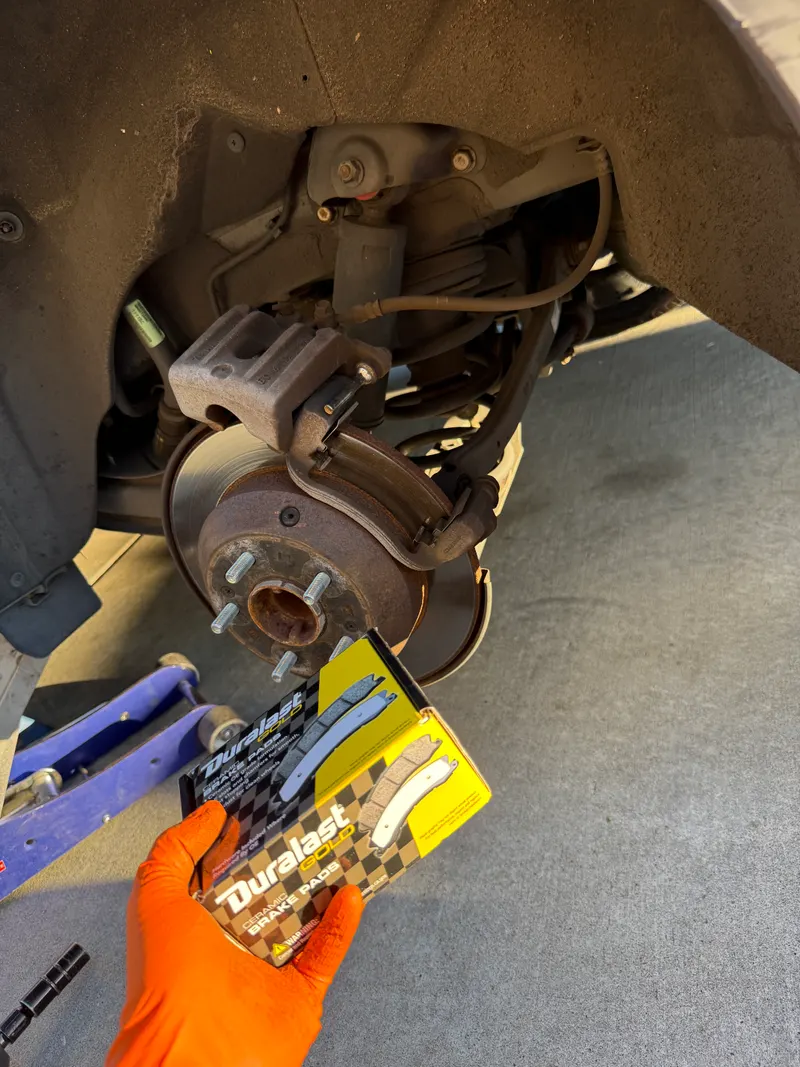
Rotor condition isn't something to guess at from the driver's seat. We inspect the rotors and pads and check how the car brakes before recommending pads only or pads and rotors together.
Other things that can cause it
Rotors are the most common answer, but not the only one. A few other problems can cause the same shake, or make a small one feel a lot worse:
- A sticking caliper or slide pins. If a caliper or its slide pins stick, a pad can keep dragging on the rotor even when you aren't braking. That overheats the rotor and leads right back to the shake. Other clues: the car pulls to one side, one wheel is much dustier than the others, or there's a hot smell after a drive.
- Worn suspension and steering parts. Worn control arm bushings, ball joints, tie rod ends or struts don't usually cause the shake on their own, but they give it room to grow. A slight rotor pulse that a healthy front end would barely show can turn into a real shimmy through loose parts. Clunks over bumps or a car that wanders on the freeway are good reasons to have the front end looked at.
- Wheel and tire problems. An out-of-balance tire, a bent wheel, or a damaged tire usually shakes at speed whether you're braking or not, but braking can make it more noticeable.

On the wheel and tire side, we'll be upfront: we diagnose it, but we don't do tire work. If balance, a bent wheel or a damaged tire turns out to be the cause, we'll tell you exactly what we found so a tire shop can take care of it. We don't do alignments either. If suspension work calls for one, we'll let you know.
Braking shake or highway shake? How to tell
You can narrow it down on your next drive. Pick a safe stretch of road with no one close behind you, and pay attention to when the shake happens:
- Only when you press the brake. Points to the brakes, most often the front rotors.
- At a certain speed with your foot off the brake, often somewhere around 55 to 70 mph. Points to wheel balance or a tire problem. A tire shop is the right first stop.
- All the time, and worse when you brake. Could be more than one thing, like a tire problem plus worn rotors or loose front-end parts. This is where a proper diagnosis pays off.
- In the brake pedal or the seat more than the steering wheel. Often points to the rear brakes.
- The car pulls to one side as you brake. Think sticking caliper or uneven wear on one side.
- Grinding, scraping, or a pedal that feels soft. Stop treating it as a comfort problem and have it checked before you drive much further.
Make a quick note of what you notice: the speed, whether it happens on hills, whether you feel it in the wheel or the pedal, and any noises. It helps a lot when you request a visit.
Is it safe to keep driving?
A mild shake when braking from freeway speed usually isn't an emergency, but it isn't something to ignore either. Uneven rotors tend to get worse, not better, and whatever is behind them (worn pads, a sticking caliper, worn front-end parts) affects how well the car stops.
Get it checked soon if the shake is getting worse, you hear grinding, the car pulls when you brake, or the brake warning light comes on. If the pedal goes soft or sinks toward the floor, treat it as a safety issue and don't keep driving it. That's one advantage of a mobile mechanic: we come to the car, so you don't have to drive it anywhere.
Brake diagnosis and repair where the car is parked
Stewart Mobile Repair comes to your driveway, office lot, or another safe parking spot. For a shake when braking, we inspect the pads, rotors, calipers and slide pins, look over the front suspension and steering parts, and check the wheels and tires for obvious balance or damage problems. Then we explain what's causing it and what we recommend, in plain language.
If it's the brakes, pad, rotor and caliper work can often be done in the same visit when the vehicle and location are suitable. If it's the front end, our suspension repair covers struts, shocks, control arms, ball joints, bushings and sway bar links. Pricing depends on the vehicle and what the inspection shows, so contact us for pricing. Parts and labor are quoted before any approved work begins.
Shopping for a used car and felt a shake on the test drive? Our guide to getting a private-seller car inspected explains how to have it checked before you buy.
We do mobile brake work across the East Bay and South Bay, including Fremont, Newark, Union City, Hayward and San Jose, plus Milpitas, San Leandro, Santa Clara, Sunnyvale and the Tri-Valley. Check our service area for the full list.
We are ASE-certified, BAR-licensed, and fully insured, and eligible repairs are backed by a 12-month / 12,000-mile warranty on parts and labor. Review the warranty terms for details.
For more detail, see mobile brake repair. You can also call or text (650) 660-6305 and tell us what you're feeling when you brake.